Kawaii, Gender, and the Limits of the “Male Gaze”
English-language criticism has an established vocabulary for discussing images like the ones I draw, and I know it well. Girls and young women depicted as cute, attractive, lightly dressed, energetic, or sexually suggestive may be described in terms of the male gaze, sexual objectification, or even the exploitation of women. I am speaking here not only of the original academic arguments associated with the term male gaze, but also of the much broader critical vocabulary that has grown around it in contemporary English-language discourse.
I do not believe that every feminist reading of this kind is nonsense. Images exist in societies, and societies have structures of gender and power. It would not be honest to pretend otherwise.
What concerns me is the assumption that this particular interpretive framework is universal. When a theoretical vocabulary developed primarily in Europe and North America is applied to Japanese visual culture as though it transparently reveals the meaning of that culture, criticism can reproduce precisely the kind of ethnocentrism that postcolonial thinkers such as Edward Said taught us to distrust. I find it troubling that this problem receives so little attention in parts of contemporary Western academia. A critique may be highly sensitive to power while remaining strangely insensitive to its own cultural power. It may become so confident in its categories that it stops asking whether the people whose images it interprets organize gender, desire, identification, embodiment, and representation in quite the same way.
The problem is not that the concept of the male gaze is useless. The problem begins when it becomes the answer before the question has even been asked.
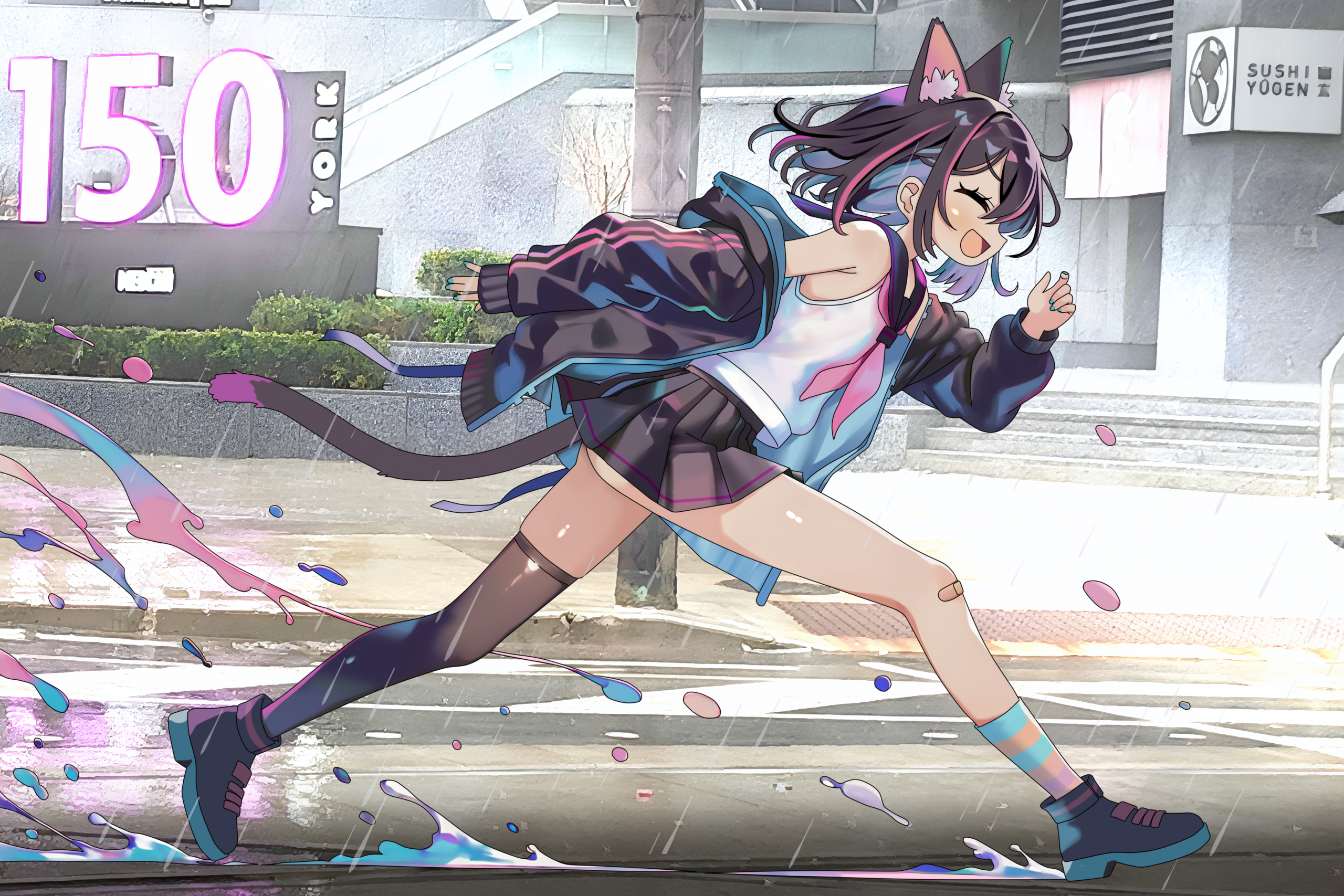
Drawing Comes Before Theory
In Japan, manga- and anime-like drawing is not an exotic specialist practice encountered only after adulthood. It belongs to the ordinary visual environment in which children grow up. I would hesitate to make the statistically stronger claim that most Japanese children draw manga, because I have not found a national survey that would justify it. But research in Japanese art education does show how readily children understand and use manga conventions. One study of fifty-one Japanese children aged six to thirteen found that they could understand, enjoy, and create meaning through manga-panel structures. [1]
This matters because drawing often begins long before an artist has acquired anything resembling an adult theory of sexuality. Children draw what they find cool, beautiful, strong, funny, cute, or free. They draw what they want to see, what they admire, what they want to possess, what they want to become, and often things for which those distinctions have not yet become meaningful.
Some people simply continue drawing from that beginning. They discover kawaii, and they keep following it.
This is also why we should be careful about imagining that a cute female character naturally implies a male producer. JILLA, the Japan Illustration Association, has conducted continuing surveys of Japanese freelance and small-scale creative workers. In its 2024 survey of 1,090 respondents, 704 were women, 343 men, and 43 chose not to answer. More strikingly for the present argument, among the 315 respondents whose principal occupation was illustration, 222 were women, 78 were men, and 15 chose not to state a gender. The survey is not a census or a random sample of every illustrator in Japan, so these figures should not be generalized beyond what they can support. But they are certainly enough to make the automatic mental image of “the male illustrator producing the cute girl” empirically questionable. [2]
The Japanese animation industry is likewise far from exclusively male. In the Japan Animation Creators Association’s 2019 survey, among 375 respondents for whom male or female sex and age were both recorded, 157 were women and 218 were men. [3]
So even before we interpret an image, the simple chain female character → male producer → male desire is unreliable. And even when the artist actually is male, another question remains: what kind of desire are we talking about?
Why Keep Drawing at All?
There is another mundane fact about drawing that sometimes disappears from theoretical accounts: drawing is expensive. Not necessarily in materials, but in life.
To become good at drawing requires thousands upon thousands of hours. Continuing professionally requires still more. It consumes time that could have been spent on more profitable work, more stable work, or simply on rest. Some artists become wealthy, of course, but most do not. JILLA’s ten-year review of freelance creators shows both a widening range of ways to obtain work and a substantial presence of relatively low-revenue businesses; in 2024, 16.9 percent of respondents reported annual sales below one million yen and another 20.5 percent between one and three million yen. [4]
The same point appears from another direction in animation. The 2019 JAniCA survey includes responses from people who describe continuing because they want to make a living drawing, because animation had been their dream since childhood, or simply because they want to keep drawing, even alongside complaints about low pay and difficult working conditions. [5]
Of course professional artists draw for money. We need to eat. But in several decades spent around animators, illustrators, and manga artists, I have met very few people who could sustain the enormous cost of drawing for years or decades only for money. People continue because something in the act of making images matters to them.
Sometimes that something is admiration.
Desire Does Not Have Only One Direction
Why does a male artist draw a girl? One possible answer is sexual attraction. I have no need to deny that. But it is not the only answer.
Another answer is remarkably simple: because the figure represents something the artist admires.
This becomes surprisingly difficult to say in contemporary English-language discourse without immediately triggering another classification. If I say that a male artist may find a girl character aspirational, one possible response is, “Are you saying that all male artists who draw girls are secretly transgender?” Another is, “Are you telling us that you are transgender?”
No. Neither conclusion follows.
Identification does not have to constitute an identity category. Admiration does not have to constitute sexual possession, and aspiration does not have to constitute a public declaration of gender identity.
A man can admire femininity. A man can want softness. A man can want to be cute. A man can feel affection for an androgynous character, for a boy in feminine clothing, or for a girl whose way of moving through the world seems somehow enviable. None of these experiences, by themselves, logically compel a person to adopt a particular identity category.
This does not mean that Japan exists outside gender binaries or that Japanese society is uniquely free from restrictive gender norms. Obviously it is not. It means something more modest but, I think, more important: the mapping from aesthetic desire to gender expression, from gender expression to sexual desire, and from any of these to social identity is not a law of nature.
It is partly—but definitely—cultural.
From outside the Anglophone world, one sometimes notices assumptions that may be harder to see from inside it. In contemporary English, questions of clothing, appearance, pronouns, attraction, and selfhood are often rapidly translated into identity categories. Those categories can be extremely useful. They can give people language for experiences that had previously been impossible to name. But useful categories can also become compulsory categories if every ambiguous experience is treated as merely an incomplete version of an identity declaration.
I am interested precisely in the ambiguity that disappears when this happens.
The Pronoun Is Already an Interpretation
The difficulty becomes visible even at the level of grammar.
Suppose I try to explain my drawings in English and write, I want her freedom, or I want to be like her. The moment I write her, English has already performed a small act of interpretation. It has placed the figure on one side of a gender boundary and me on the other. There is she, the female figure, and there is I, the person looking at her.
That is not necessarily how the image exists for me while I am drawing it.
Japanese routinely permits subjects and other arguments to remain unstated when context makes them recoverable. In linguistic terms, Japanese allows null arguments and extensive pronoun omission in places where ordinary English strongly prefers or requires an overt subject. [6] This is not merely a grammatical curiosity when one is trying to describe an experience whose boundaries are themselves uncertain.
I do not need to claim that language determines thought. I am not proposing a strong version of linguistic determinism. It is enough to observe that translation can force us to state distinctions that were not explicit in the original experience.
Japanese can simply leave something unstated. English becomes impatient: Who is this? He? She? They?
Even they does not necessarily solve the problem. In contemporary English, deliberately using they for a character who is visually read as a girl may itself be understood as an assertion about that character’s gender identity. The attempt to avoid one classification can produce another.
Sometimes the problem is not that I have difficulty answering the question. The real problem is the question was not present in the first place. It was introduced by a Western interpretive framework.
This is also why I want to be her is not quite right for what I am describing. Sometimes the figure is not simply her, but neither is the figure literally me. While drawing, the boundary may simply not matter very much.
The Japanese word “sunao” (素直) is useful here, although no single English word reproduces it. Depending on context it may suggest being straightforward, open, receptive, unforced, honest with one’s own feeling, or not unnecessarily twisted away from one’s natural response. That is close to what I want from these images.
What attracts me may be lightness, freedom, ease in the body, energy, cuteness, openness, or an absence of embarrassment about simply existing in a body. I do not first encounter those qualities as possessions of a female Other. They are qualities I admire, qualities I enjoy drawing, and sometimes qualities I would like to inhabit.
Language does not have to determine thought for translation to impose a distinction that was not present in the original thought. Once that distinction has been imposed, an entire theory of gender can quietly follow it.
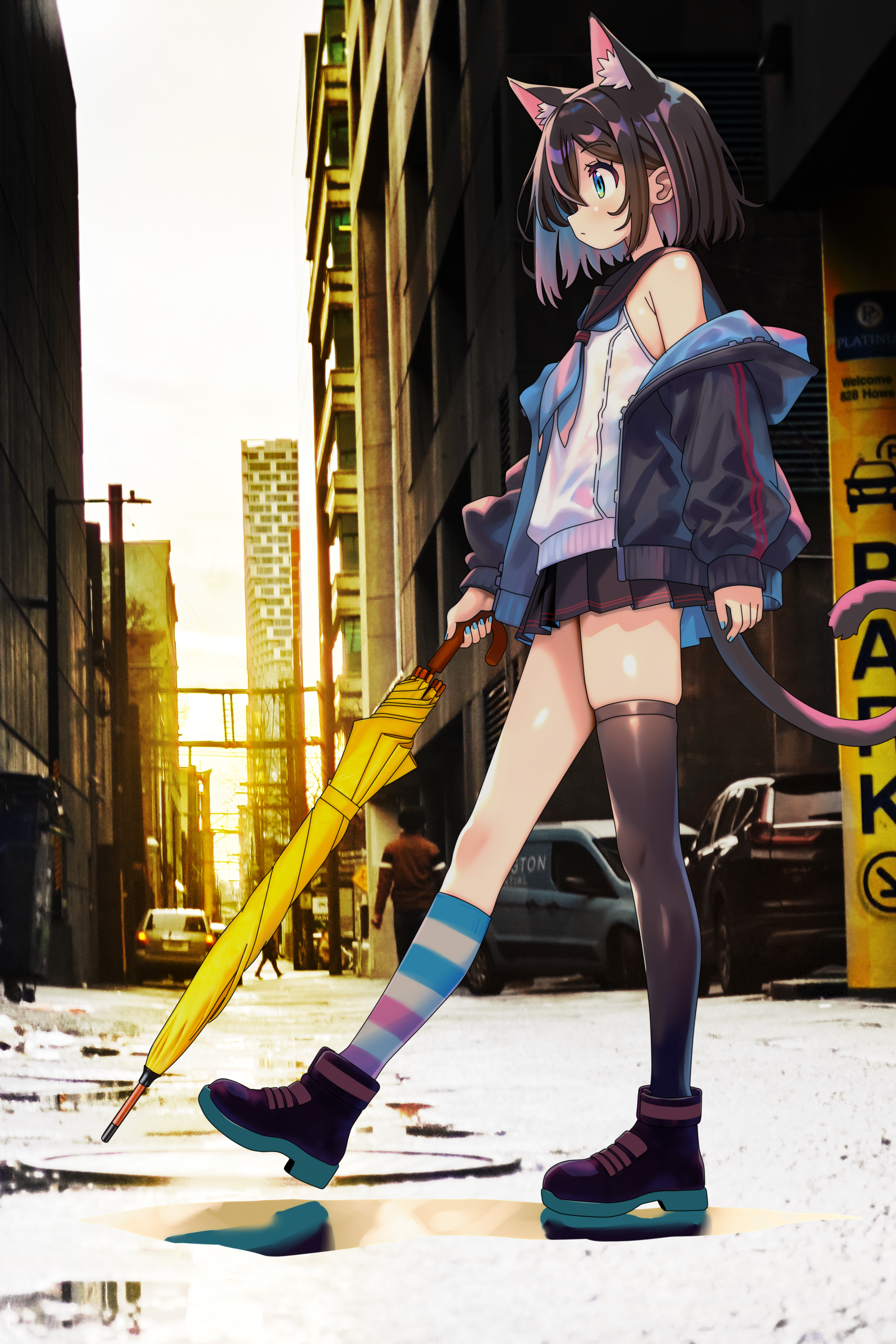
Aspiration Is Not Possession
This distinction matters to my own work. When I draw a lively figure in shorts, a camisole, an oversized jacket, or some other garment conventionally read as feminine, the finished image may certainly carry sexual connotations. I am not interested in pretending that viewers cannot see them.
But the presence of a sexual connotation does not tell you everything about the desire that produced the picture.
The relevant desire is not always I want this girl. Nor must it therefore be I want to become a woman. Sometimes it is much closer to I want something of this way of existing.
That difference matters. The image can contain an aspirational self-representation without being a literal self-portrait. It may represent a possible body, a possible manner of dress, a possible way of moving, a possible relation to one’s body, or simply a way of being alive that feels desirable.
Perhaps aspirational self-representation is the closest phrase English gives me. Even that sounds considerably more theoretical than the feeling itself.
This is where “sunao” matters. I am not drawing these characters in order to announce a political program for women, nor am I drawing them in order to announce a political program for men. I am trying to remain honest to an attraction toward particular forms of being: brightness, directness, physical freedom, playfulness, activity, beauty, and cuteness.
To call this immediately sexual possession is one interpretation. To call it immediately transgender identification is another. Either may sometimes be relevant; sometimes neither is. Why must either one—or both—be compulsory?
Looking Is Not Always Separate from Being
Much criticism organized around the idea of the male gaze depends, explicitly or implicitly, on a relatively stable structure. We should remember that this division itself reflects a distinctly Western intellectual tradition. Someone looks; someone is looked at. There is a subject and an object, and gender helps determine which is which.
That structure undoubtedly describes many real images and many real acts of looking. I do not think it describes every act of drawing.
Drawing is an especially strange activity because the person looking is also constructing the body being looked at. The hand that makes the figure is not necessarily standing entirely outside that figure. The image can be admired as an image while simultaneously operating as a possible form of oneself.
An artist may sexually desire a figure, identify with it, envy it, protect it, admire it, become it imaginatively, remember something through it, or simply enjoy its shape and movement. Several of those relations may exist simultaneously, and their proportions may change from one drawing to another.
For this reason, a criticism that moves too quickly from male artist and female figure to male subject and female object may have made its decisive mistake before the analysis even begins. It has not merely assigned a potentially incorrect motive to the artist. It has assumed that the distinction between the subject looking and the object being looked at is stable in the first place.
In much of my work, it is not.
Kawaii Is Not the Opposite of Agency
There is another reason I resist some interpretations of cute characters. The qualities I repeatedly connect with kawaii are not passivity, helplessness, or submission. They are cheerfulness, brightness, openness, energy, liveliness, activity, and sunao.
There is a reason the characters I like to draw keep moving. They run, laugh, stretch, dress in ways they enjoy, occupy space, and seem at ease with their own physical existence. Their bodies are not burdens for which they must constantly apologize. Their cuteness is connected to vitality.
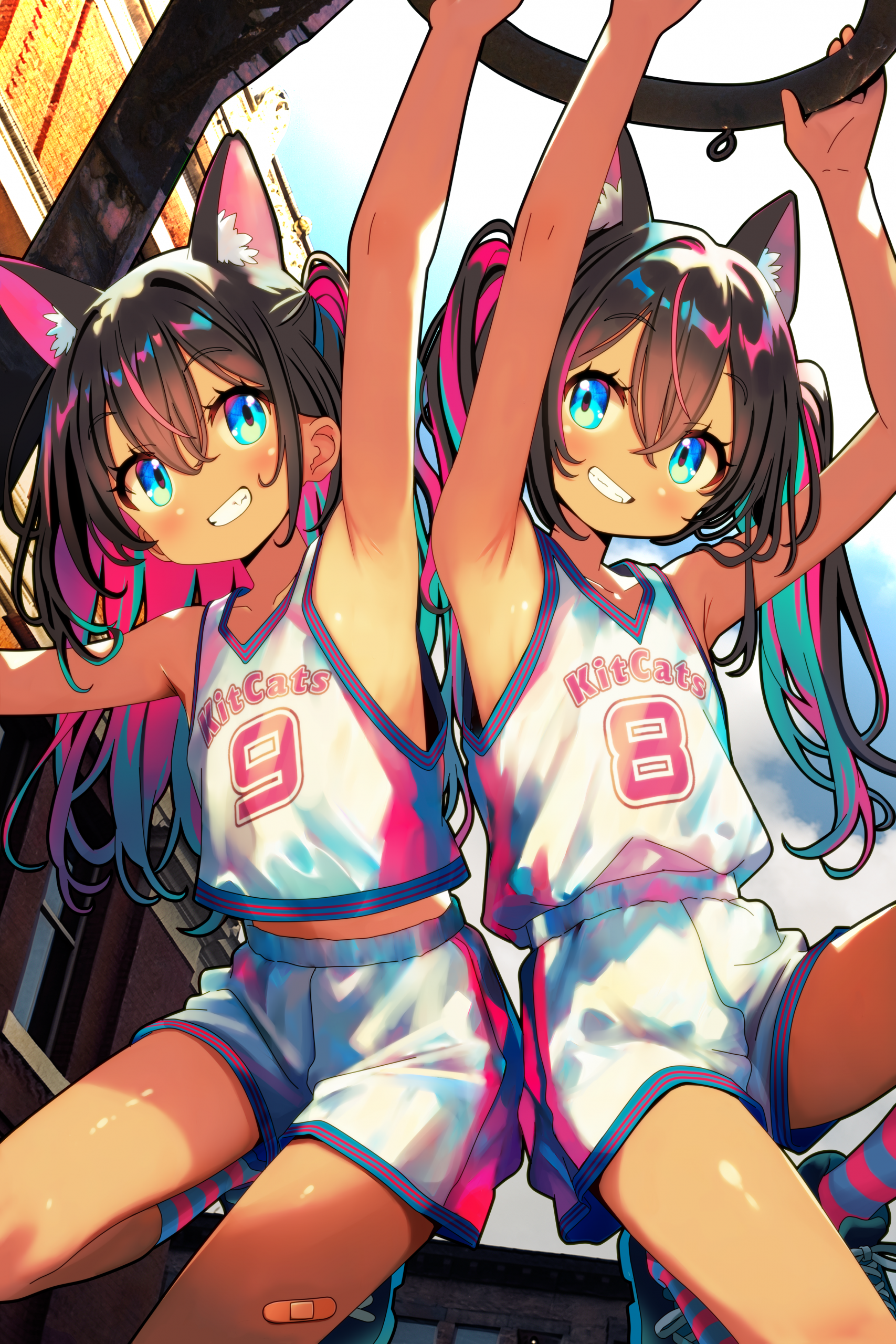
This connection is central to my work. I do not experience kawaii merely as a technique for making a body consumable to another person. I also experience it as a way of imagining a body that is comfortable being alive.
That is a very different proposition.
The Cultural Risk of Universal Translation
This brings me back to the larger problem of cultural interpretation. I do not object to Western feminist criticism simply because it is Western, nor do I believe Japanese culture is uniquely authentic, innocent, or immune to sexism. That would merely reverse one ethnocentrism into another.
What I object to is the conversion of a historically and culturally situated interpretive framework into a universal diagnostic machine.
Postcolonial criticism spent decades teaching us to be suspicious of the moment when one culture becomes confident that its categories transparently explain another. That lesson should not disappear merely because the categories now arrive with morally admirable intentions.
A theory can be ethically motivated and still be culturally provincial. A critic can oppose domination while unconsciously treating one cultural vocabulary as the default language of human experience.
The alternative is not to abandon concepts such as objectification or the male gaze. It is to restore uncertainty to interpretation. Ask who made the image, in what culture, within what visual conventions, and through what personal history. Ask what relation the artist has to the body being drawn. Allow for the possibility that admiration, aspiration, identification, sexuality, memory, affection, humor, play, and self-representation may coexist rather than excluding one another.
Most importantly, do not assume that the category brought to an experience must be more real than the experience itself.
Please Read My Characters as Aspirations Too
When you encounter one of my characters, then, I am not asking you to abandon feminism or to promise never to analyze an image politically. I am asking for something smaller and, I think, more reasonable: do not assume that you already know where the desire in the picture is pointing.
A person may desire another person. A person may desire an image. But a person may also direct desire toward an image as a possible way of being: toward a possible body, a possible attitude, a possible freedom, or a possible way of moving through the world.
My characters are, among other things, expressions of admiration. They are sometimes forms of aspiration. Sometimes they contain a great deal of me. Sometimes they do not. Sometimes the distinction is not especially important.
What I want preserved is the possibility that a cute body can be drawn not only as an object to be possessed, but also as a form of life to be approached imaginatively.
For me, the connection between sunao, brightness, energy, activity, and kawaii is not incidental. It is one of the reasons I draw. I understand these qualities as an affirmation rather than a retreat: a way of saying that being alive in a body can be light, joyful, active, and beautiful.
That is how I would like my work to be read, too.
Sources
- https://www.jstage.jst.go.jp/article/aaej/44/0/44_193/_article/-char/ja
- https://jilla.or.jp/2026/07/15919 — https://prtimes.jp/main/html/rd/p/000000004.000169722.html
- https://www.janica.jp/survey/survey2019Report.pdf
- https://jilla.or.jp/2026/07/15919
- https://www.janica.jp/survey/survey2019Report.pdf
- https://www.researchgate.net/publication/32895142_Radical_Pro_Drop_and_the_Morphology_of_Pronouns